
A World Inequality Lab paper reveals significant land inequality in rural India, with the top 10% of households owning 44% of the land, while 46% are landless. The study highlights the impact of historical institutions, social stratification, and agro-ecological conditions on land distribution.

India is set to become the world's fourth-largest economy in 2025, but slow income growth, lack of structural change, and rising inequality highlight the gap between progress and real transformation.
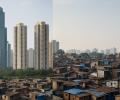
A larger part of India's population was in the middle 40 per cent of the national income share in 1980. Today almost all are in the bottom 50 per cent.

Inequality in India has skyrocketed since early 2000s, with the income and wealth share of top 1 per cent population rising to 22.6 per cent and 40.1 per cent, respectively, in 2022-23, according to a working paper. The paper titled 'Income and Wealth Inequality in India, 1922-2023: The Rise of the Billionaire Raj' said between 2014-15 and 2022-23, the rise of top-end inequality has been particularly pronounced in terms of wealth concentration.

The paper said that the taxation proposal needs to be accompanied by explicit redistributive policies to support the poor, lower castes, and middle classes.

'Previously, contributing only 25 per cent of material costs, states now face burdens of 40 per cent to 100 per cent of total costs, ensuring poorer states will curb project approvals, directly stifling work demand.'

A top Swiss official has emphasised the growing importance of science and technology in international affairs, leading Switzerland to prioritise anticipatory science diplomacy in its foreign policy. Collaboration with India reflects a shared vision between two global innovation leaders.
Wealth, which can broadly be a measure of assets held as opposed to income earned, is unequally distributed.

India stands out as a poor and very unequal country, with the top 1 per cent of the population holding more than one-fifth of the total national income in 2021 and the bottom half just 13 per cent, according to a report. The report, titled ' World Inequality Report 2022', has been authored by Lucas Chancel, co-director of the World Inequality Lab, and coordinated by several experts, including French economist Thomas Piketty. It further said India is now among the most unequal countries in the world.

While other backward classes had a share of 9 per cent, there were no scheduled tribe billionaires.

A map showing the gender equality across the world as published in the 'Global Gender Gap Report 2014' of the World Economic Forum.

'Modigate is snowballing into a huge thing with the electorate. The BJP is in for huge punishment by the electorate.'

Several companies and technology heavyweights including Microsoft, Oracle and Salesforce are working to create a digital vaccination passport or health passport app in the hope that governments and airlines will require travellers to upload details of their Covid-19 tests and immunisation. The vaccine passport will effectively create digital credentials that could be the key to attending crowded events or even visiting countries.

Why are the poor turning Right instead of turning toward far-Left parties, ponders Pranab Bardhan.

Don't expect the synthetic stones to surpass natural ones anytime soon because the world's biggest miners of diamonds aren't looking to get into man-made diamonds.

Disale announced that he will be sharing 50 per cent of his prize money with his fellow finalists to support their "incredible work".
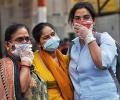
'And that means all of us have to be very careful.'

Can we make high speed 4G Internet available at 10 cents per GB, and make all voice calls free of cost -- that too in a large and diverse country like India? Can we make high-quality but simple breast cancer screening available to every woman, that too at the extremely affordable cost of $1 per scan? Can we make a portable, high-tech ECG machine which can provide reports immediately and that too at the cost of 8 cents a test? Can we make an eye imaging device that is portable, non-invasive and costs 3 times less that conventional devices? Can we make a robust test for mosquito-borne dengue, which can detect the disease on day 1, and that too at the cost of $2 per test? Amazingly, says Dr R A Mashelkar, the eminent scientist, all this has been achieved in India, not only by using technological innovation but also non-technological innovation.

'Let me talk about young Indian startups with their hearts in the right place and how they are proving that innovations that represent 'affordable excellence' -- breaking the myth that 'affordability' and 'excellence' cannot go together -- is indeed possible!' says Dr R A Mashelkar, the eminent scientist, in this fascinating feature.
Internet-based systemic wisdom connects machines and people, and will drive next-gen enterprises, said Huawei's Yatish Nagavalli.

After snapping his political alliance with the ruling National Democratic Alliance at the Centre, N Chandrababu Naidu, chief minister of Andhra Pradesh, speaks to B Dasarath Reddy on what he now has in mind.
